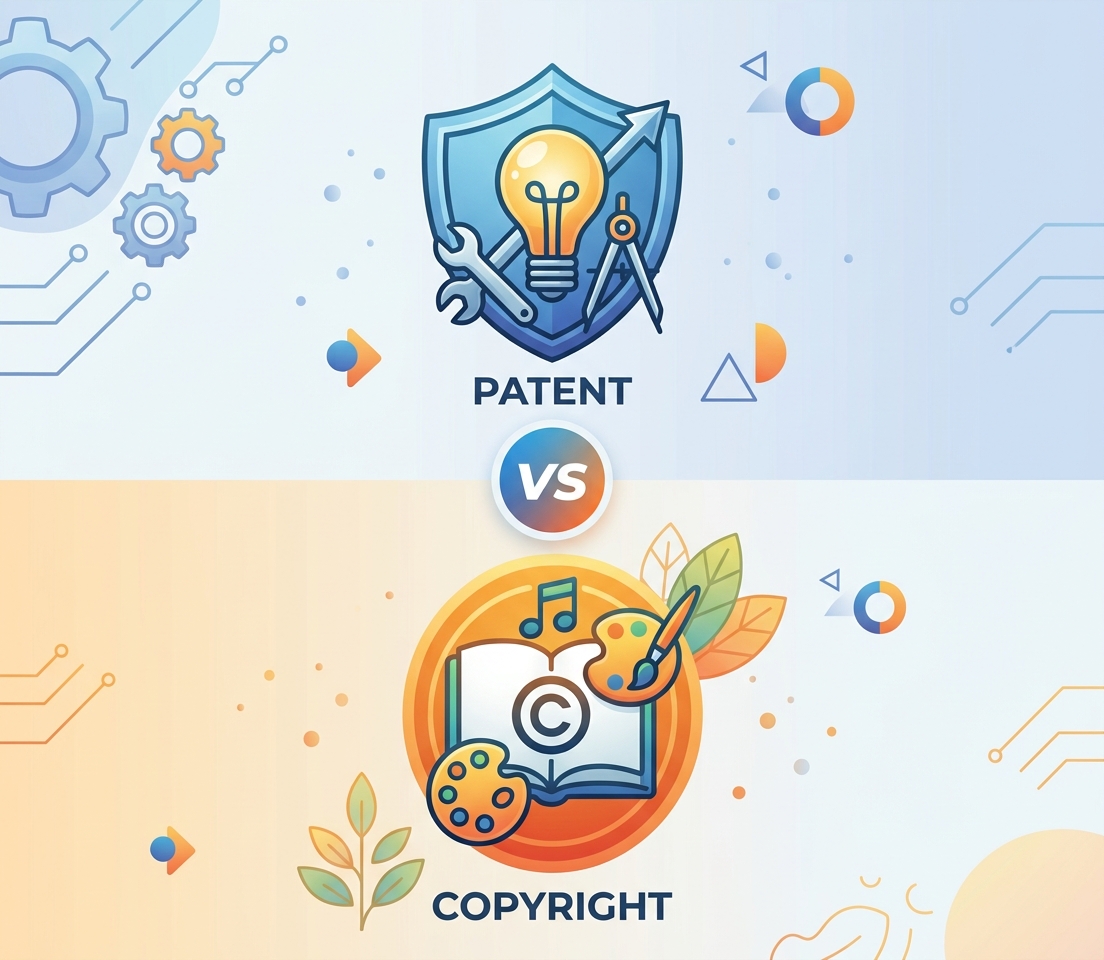
Patent vs copyright comes down to what each one protects. A patent protects how something works, meaning a new and inventive technical solution, and lasts 20 years from filing. Copyright protects how something is expressed, such as text, code, music or images, and lasts for the author's life +50 years. Patents require formal examination and official grant. Copyright subsists automatically upon creation.
Patent vs copyright at a glance
The difference between patent and copyright runs through five practical questions. The figures below are for the UAE, under Federal Decree-Law No. 11 of 2021 on Industrial Property and Federal Decree-Law No. 38 of 2021 on Copyright.
| Patent | Copyright |
What is protected | A functional invention: a product, process or technical improvement. Not the idea behind it | The expression of a work: text, code, music, film, art, photographs, databases. Not the idea behind it |
Requirements | Novelty, inventive step and industrial applicability (Art. 5). Disclosure before filing destroys novelty, subject to a 12-month grace period for the inventor's own disclosures | Originality and a human author. The work must be an "innovative production" in fixed form (Art. 1) |
Duration | 20 years from filing, with annual fees throughout. A utility certificate, which needs industrial application but no inventive step, runs 10 years (Art. 18) | The author's life +50 years, or 25 years from publication for applied art (Art. 20) |
Rights granted | Stops others making, using, selling or importing the invention, even if they developed it independently | Economic rights over reproduction, adaptation, distribution and performance (Art. 7), non-waivable moral rights (Art. 5). Independent creation is a defence |
Cost and process | Substantive examination by the Ministry of Economy. AED 2,000 to file and AED 2,000 to AED 9,000 to examine by claim count, halved for SMEs and academic institutes. Years to grant | Automatic on creation. Deposit is optional under Art. 4 and costs AED 50 for an individual or AED 200 for a company, in about three working days |
Patents provide broader protection by excluding independent inventors who never saw your work, but require formal examination and annual fees to maintain.
A UAE patent protects you in the UAE and nowhere else, and there is no longer a single filing covering the Gulf: the GCC Patent Office stopped accepting new applications on 6 January 2021, so the UAE, Saudi Arabia and Oman now file nationally. Copyright travels. Under the Berne Convention it is recognised automatically in more than 180 countries, with no filing anywhere.
What does a patent protect?
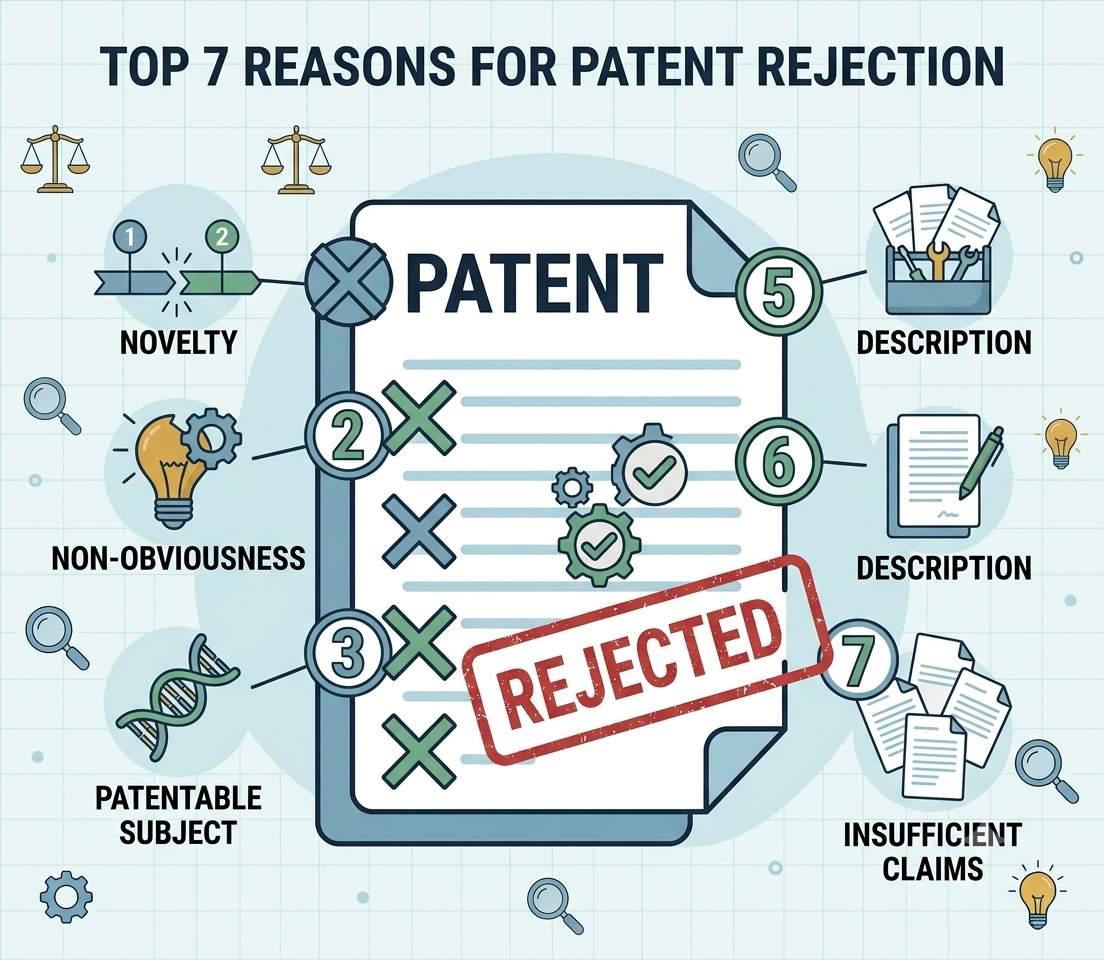
A patent protects a technical solution to a technical problem. Article 5 of Federal Decree-Law No. 11 of 2021 sets three tests, and an application fails if it misses any one of them.
- Novelty. The invention must not have been disclosed anywhere before filing, in writing, orally or through use. Article 5(4) gives a 12-month grace period, but only for disclosures by the inventor or someone who learned of it from them. A trade show demonstration or a published paper can end the application before it starts.
- Inventive step. Under Article 5(5), the invention must not be self-evident to an ordinary person skilled in the field. Combining two known components in the obvious way is not enough.
- Industrial applicability. The invention must be capable of being made or used in industry.
Article 7 then removes whole categories from patentability, whatever their merit: plant and animal species and biological production methods, diagnostic and surgical methods, scientific theories and mathematical methods, schemes and rules, business methods, games, and computer programs.
Where a patent is infringed, Article 69 provides for imprisonment and a fine of AED 100,000 to AED 1,000,000, well above the AED 10,000 to AED 100,000 that Article 39 of the copyright law sets.
Real-world example: a self-cleaning solar panel filter
An engineering firm in Sharjah develops a filter housing that keeps dust off rooftop solar panels without water, using a vibrating mesh triggered by a drop in output.
The concept of keeping panels clean is not patentable, because it is an idea. The mechanism is, if it has not been shown publicly, is not obvious to a skilled solar engineer, and can be manufactured. A granted patent stops a competitor selling the same mechanism for 20 years from filing, even one who developed it independently and had never heard of the firm.
What does a copyright protect?
Copyright registration protects expression rather than function. Article 1 of Federal Decree-Law No. 38 of 2021 defines a work as "every innovative production in the field of literature, arts or science," and the author as the person who creates it. Article 2 lists twelve protected categories, covering written works, software and databases, music, film, artistic works and photographs.
Three features separate copyright from a patent, and each changes what you can enforce.
- Protection starts before you file anything. Copyright exists from the moment the work takes fixed form, and Article 4 makes deposit optional without reducing protection. A Ministry of Economy filing is evidence of ownership, not its source.
- Independent creation is a complete defence. If a competitor reaches a similar result without access to your work, there is no infringement, a gap a patent does not have.
- Moral rights survive whatever the contract says. Under Article 5 of the copyright law, attribution, first publication and objecting to distortion cannot be waived or transferred, and they belong only to human authors.
Real-world example: a recorded song
A Dubai songwriter writes a track and records it. Two separate rights arise. The lyrics and composition are a protected work under Article 2, running for the writer's life for 50 years. The recording is a separate right, protected for 50 years from the date it was made.
What is not protected is the chord progression as a musical idea, the genre, or the subject of the lyrics. Article 3 puts ideas, procedures, concepts and principles outside protection. Another writer can produce a song about the same thing, in the same style, over the same four chords, and infringe on nothing.
Can something be both patented and copyrighted?
Yes, and the two rights cover different layers of the same product. This is where the patent vs copyright question stops being a choice and becomes a combination. In a machine, the mechanism can be patented while the manual, the interface graphics and the control software are copyright works. The protections do not overlap, and losing one does not affect the other.
Software example: a payment routing engine
A fintech company in Abu Dhabi builds an engine that routes card transactions across acquirers to reduce transaction declines.
- The source code is copyright. Article 2 of Federal Decree-Law No. 38 of 2021 protects software and databases as works. Protection is automatic, and Article 41 sets a minimum fine of AED 30,000 for unauthorised use of software.
- The routing method is hard to patent. Article 7(1) of Federal Decree-Law No. 11 of 2021 excludes computer programs, and business methods with them. Where an invention delivers a genuine technical effect beyond the program itself, practitioners argue it should still qualify, but the Ministry has published no guidance and UAE practice remains unsettled.
- The product name and logo are trademarks, registrable under Federal Decree-Law No. 36 of 2021.
- The routing logic and thresholds can be trade secrets, protected under Articles 61 to 63 of the industrial property law for as long as they stay confidential.
For most software businesses the answer is copyright for the code, trademark for the brand, and trade secret for what a customer never sees.
Copyright vs patent vs trademark vs trade secret
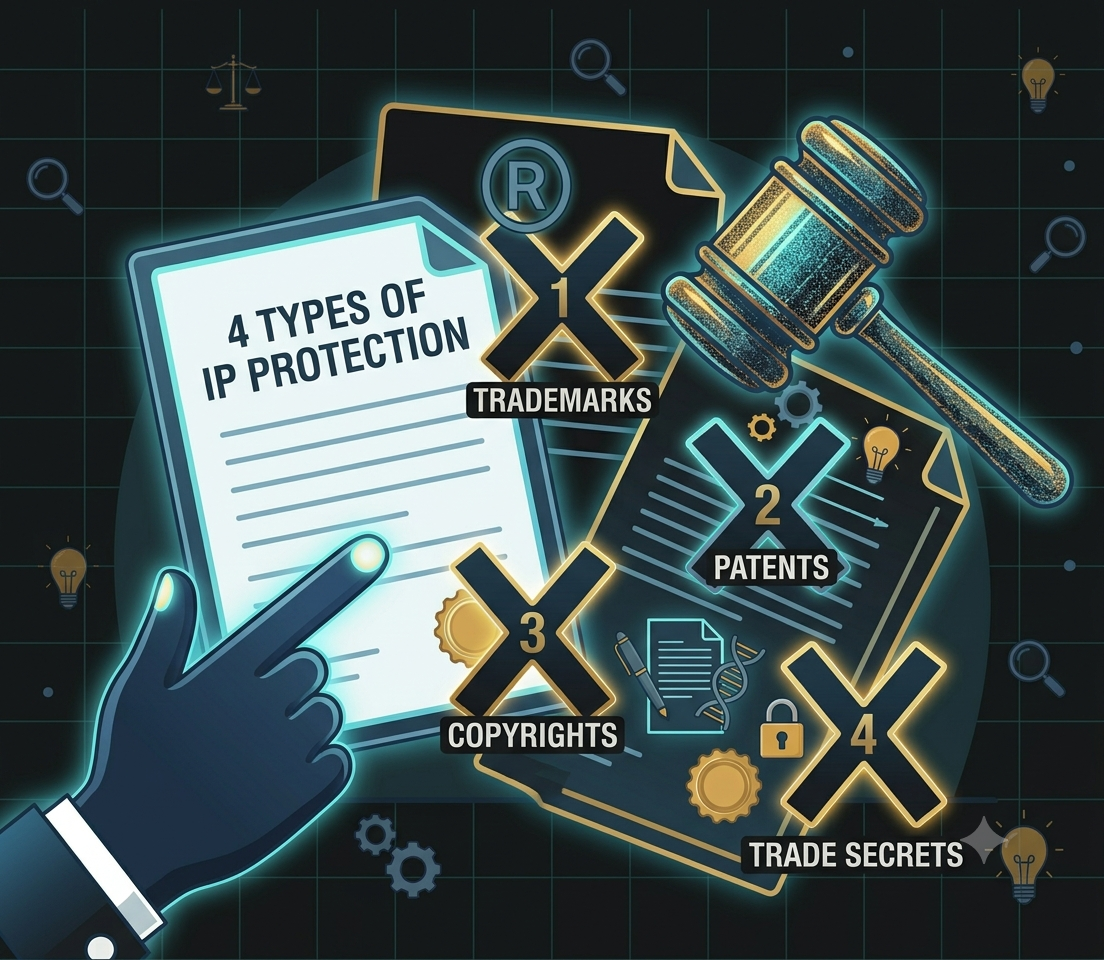
These rights are often treated as alternatives. They are not, and most businesses hold several at once.
1. Patent: How a product works for 20 years from filing
2. Industrial design: How a product looks: its shape, pattern or ornamentation, 20 years from filing (Art. 45, Decree-Law 11/2021)
3. Copyright: How an idea is expressed, Life +50 years, Automatic
4. Trademark: Signs that distinguish goods or services, including words, logos, 3D shapes, sounds and holograms (Art. 2, Decree-Law 36/2021), 10 years from the application date, renewable indefinitely (Art. 21), Required, per class
5. Trade secret: Commercially valuable information kept confidential, Indefinite, while secrecy holds, None
Industrial design is routinely overlooked. A patent covers how a product works and copyright covers expression, which leaves how it looks sitting between them.
Trade secrets are the ones businesses most often hold without realising. Articles 61 to 63 of Federal Decree-Law No. 11 of 2021 protect undisclosed information on three conditions: it is not generally known among people in the field, its value comes from being secret, and the holder has taken reasonable steps to keep it that way. No filing is needed, and protection lasts as long as the secret does. Lose the third condition and you lose the right.
How to decide which protection you need
Work through these in order. The examples above settle the first question; the rest decide cost and timing.
- Is it how something works, or how something is expressed? Protecting creative assets requires clear separation between utility and expression. Utility secures patents, while expression protects copyright.
- Have you disclosed it publicly? If an invention has been shown, sold or published, novelty is gone. You have 12 months from your own disclosure under Article 5(4), and nothing if someone else disclosed it first. File before you launch.
- Can a competitor reverse-engineer it? If yes, a patent is worth the cost, because a trade secret will not survive a teardown. If no, and the advantage sits in a process nobody sees, a trade secret costs nothing and never expires.
- How fast do you need enforceable rights? Copyright is enforceable immediately. A patent takes years and can be refused after you have spent the fees.
- Is it a name, logo or slogan? That is a trademark question, not a copyright one. Register per class, and note that a trade name registered with your emirate's economic department is not a trademark and gives no rights across the UAE.
- Who created it, and under what contract? Article 28 of the copyright law vests employee and commissioned work in the employer or commissioning party where it relates to the engagement. Article 10 of the patent law does the same for inventions made under contract, unless the contract says otherwise, though an inventor whose invention proves worth far more than anticipated can ask a court for further compensation. Get this in writing before the work starts.
One habit is worth more than any of the six: keep dated records of what was created, by whom and when. Every one of these rights eventually turns on proving that.