Abu Dhabi is a major global hub for commerce and international investment. For investors entering the Middle Eastern market, free zones in Abu Dhabi offer major incentives like complete foreign ownership and tax advantages.
Choosing the right jurisdiction requires understanding how these areas function compared to traditional mainland setups.
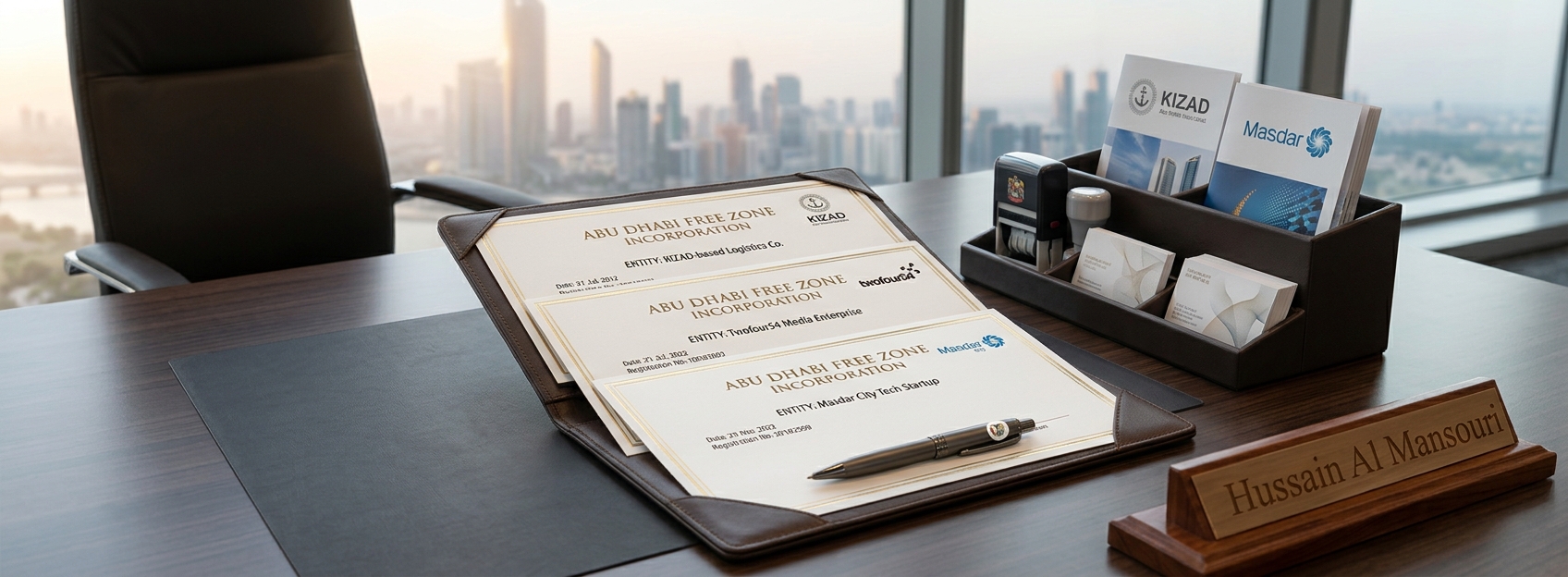
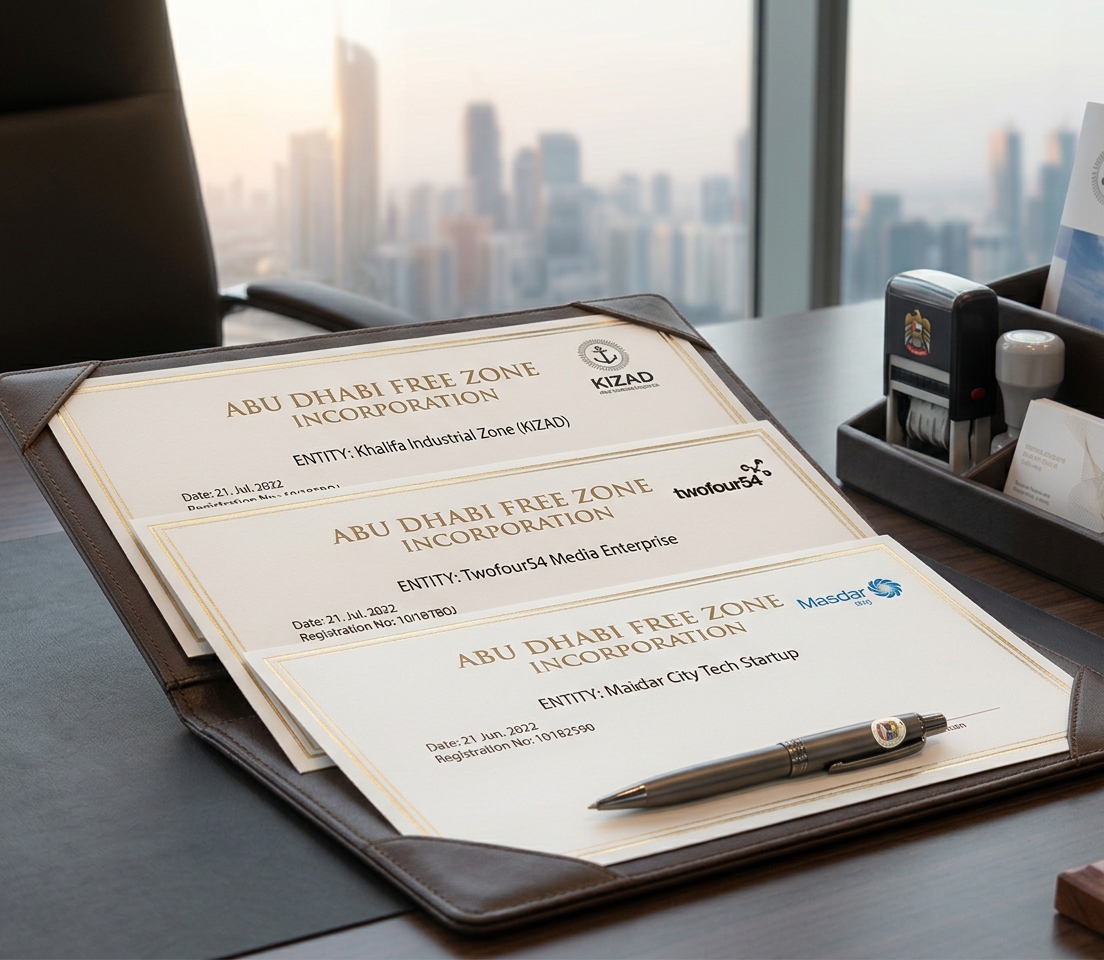
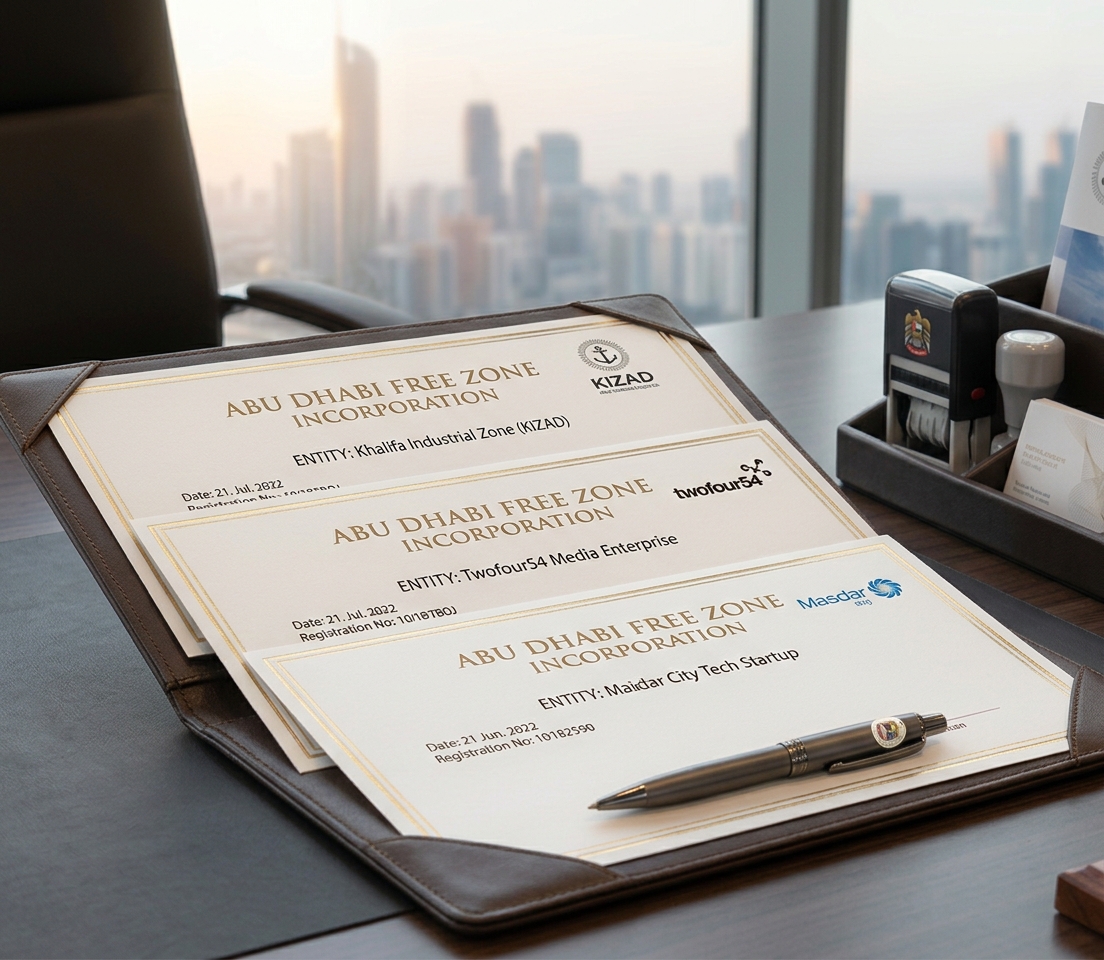
Abu Dhabi features several specialized economic hubs built for distinct industries. You can select from the financial framework of the ADGM free zone, the industrial access of the KEZAD free zone, the green tech focus of the Masdar City free zone, the creative community of the twofour54 free zone, or the aviation logistics of the ADAFZ free zone.
This guide covers the complete Abu Dhabi free zone list and outlines how to set up a company in the Abu Dhabi free zone.
Choosing Between Mainland and Free Zone in Abu Dhabi
Before deciding where to incorporate, investors must weigh the operational differences of an Abu Dhabi free zone vs mainland setup.
Geographic Scope & Trade: Mainland companies can trade directly anywhere within the UAE local market and bid on government contracts without a local distributor. Free zone companies are primarily designed for international trade and business within their specific zone, though they can trade locally within the UAE through a licensed local distributor or agent.
Ownership: Free zones traditionally offer 100% foreign ownership without requiring a local Emirati partner. (While UAE mainland regulations have evolved to allow 100% foreign ownership for many commercial and industrial activities, certain strategic sectors still maintain specific nuances).
Taxation and Customs: Free zones provide access to a 0% corporate tax rate on Qualifying Income (subject to maintaining economic substance regulations and meeting compliance criteria) and offer complete duty exemptions on goods imported into the zone for re-export.
Regulatory Environment: Free zones operate under their own independent regulatory authorities and specialized legal frameworks (such as the common law system in the ADGM free zone), whereas mainland entities are directly governed by federal UAE commercial companies laws and the Department of Economic Development (DED).
What is a Free Zone?
A free zone is a designated, fenced-in geographic area within the UAE that operates under special economic and regulatory rules distinct from the rest of the mainland. Established to attract foreign direct investment (FDI), these zones function as autonomous economic ecosystems.
Key characteristics and benefits of setting up within an Abu Dhabi free zone list include:
Full Ownership: Complete exemption from local sponsor or partner requirements, allowing investors to retain 100% control of their business assets and profits.
Repatriation of Capital and Profits: Zero foreign exchange controls, allowing 100% repatriation of both capital and generated profits back to your home country.
Tax Advantages: Exemption from import and export duties, alongside attractive corporate tax rates for qualifying activities.
Streamlined Setup: Simplified administrative procedures, centralized single-window licensing services, and on-site government processing that make setting up a company in the Abu Dhabi free zone fast and efficient compared to traditional mainland setups.
Mainland vs Free Zone: Key Differences
When establishing a business presence in the UAE capital, selecting the right jurisdiction dictates your operational reach, corporate structure, and compliance requirements.
Below is a clear comparison of an Abu Dhabi free zone vs mainland establishment:
Feature | Abu Dhabi Free Zone | UAE Mainland |
Ownership | 100% foreign ownership allowed. | 100% foreign ownership permitted for most commercial/industrial sectors (subject to specific strategic constraints). |
Market Access | Direct international trade and local trade via a local distributor or agent. | Direct trade anywhere within the UAE local market and eligibility to bid on government tenders. |
Governing Authority | Governed by independent Free Zone Authorities (e.g., ADAFZ, ADGM, KEZAD). | Governed by the Abu Dhabi Department of Economic Development (DED) and federal laws. |
Taxation & Customs | 0% corporate tax on qualifying income, personal tax exemptions, and total customs exemptions on re-exports. | Subject to standard federal corporate tax and standard UAE customs regulations. |
Workspace Requirement | Must lease physical or flexi-desk office/warehouse space within the specific designated zone boundary. | Flexibility to lease commercial real estate anywhere across the mainland of Abu Dhabi. |
The Five Abu Dhabi Free Zones are
Abu Dhabi hosts specialized economic hubs tailored to distinct industries. Below is a detailed breakdown of the five premier free zones:
1. Abu Dhabi Airports Free Zone (ADAFZ free zone)
- Overview: Strategically spans several of the emirate's key aviation hubs, offering integrated business parks, logistics hubs, and executive service centers at Abu Dhabi International Airport, Al Ain International Airport, and Al Bateen Executive Airport.
- Permitted Activities: Aviation, aerospace, aircraft interiors, charter services, import/export, in-flight catering, flight support, logistics, warehousing, distribution, marketing, maintenance/repair/organisation (MRO), regional HQ functions, consultancy, ICT, and light manufacturing.
- Entities Allowed: Limited Liability Companies (LLCs) and branch offices (foreign or local).
- Share Capital Requirements: Varies based on activity type and shareholder profile. Historically structured higher for specialized sectors like aerospace, aviation, and manufacturing compared to standard service segments.
- Minimum Governance Structure: Requires at least one shareholder, one director, and a general manager.
2. Abu Dhabi Global Market (ADGM free zone)
- Overview: Abu Dhabi's premier international financial free zone, established on Al Maryah Island and expanding across Al Reem Island. ADGM operates as an independent common law jurisdiction, applying rules and regulations directly rooted in the English common law system, backed by its own independent ADGM Courts.
- Permitted Activities (Broad Categories):
- Financial: Banking, financial advisory, investment advisory, trust services, and fintech.
- Non-Financial: Manufacturing, civil engineering, hospitality, real estate, legal/accounting services, advertising, and consulting.
- Retail: Manufacturing and retail sale of food items, beverages, and jewelry.
- Entities Allowed: Private companies limited by shares, Special Purpose Vehicles (SPVs), foundations, public companies, branches, limited partnerships, cell companies, and specialized trust structures.
- Share Capital & Structure Requirements: No minimum share capital for many entity types (though FSRA-regulated financial entities face explicit capital adequacy rules). Minimum management requires one shareholder, one authorized signatory, and one director.
3. Masdar City Free Zone (Masdar City free zone)
- Overview: Founded in 2006 as part of Masdar (Abu Dhabi Future Energy Company), Masdar City Free Zone is designed to position the UAE as a global leader in renewable energy and sustainable urban development. It serves as a specialized business hub embedded within the world-famous sustainable urban community.
- Permitted Activities: Renewable energy, clean tech, ICT, energy industry operations, oil and gas services, plus a broad non-energy ecosystem including marketing, healthcare, business consultancies, property development, regional HQs, and community retail services.
- Entities Allowed: Free Zone Limited Liability Companies (FZ-LLCs), branch offices, and association (non-profit) licences.
- Share Capital Requirements: Standard minimum capital requirement of AED 50,000 for LLC structures (branches carry no minimum share capital requirement).
- Minimum Governance Structure: Requires at least one shareholder, a director, a general manager, and a company secretary.
4. Khalifa Economic Zones Abu Dhabi (KEZAD free zone) — formerly KIZAD
- Overview: Abu Dhabi's premier integrated trade, logistics, and industrial economic zone, launched in 2012 under Abu Dhabi Ports Company. Situated strategically at Al Taweelah between Abu Dhabi and Dubai with direct multimodal connectivity to Khalifa Port.
Licence Types Issued: - Industrial: Permits import of raw materials, manufacturing, processing, assembling, packaging, and export.
- Trading: Permits import, export, distribution, stocking, and warehousing of specified products.
- Service: Permits management/economic consulting, marketing, cargo/freight forwarding, and catering.
- Entities Allowed: Limited Liability Companies (LLCs) and branch offices.
- Share Capital Requirements: Baseline minimum paid-up share capital requirement of AED 150,000 for LLC structures, subject to industrial scaling.
- Minimum Governance Structure: Requires at least one shareholder, a minimum of two directors, a general manager, and a company secretary.
- Customs Treatment: Offers distinct duty relief on imported raw materials held in bonded status for re-export, or exemptions for qualifying joint ventures trading within the GCC.
5. twofour54 (twofour54 free zone)
- Overview: Abu Dhabi's dedicated media, entertainment, and gaming free zone, built to cultivate a world-class creative industry cluster, support the emirate as a premier international filming location, and grow local content and media talent.
- Permitted Activities: Advertising, animation, branding, content management/portal management, audio-visual production, event management, gaming development, graphic design, news gathering, post-publishing, and broadcasting (satellite/radio).
- Entities Allowed: Free Zone Limited Liability Companies (FZ-LLCs), branch offices, and specialized freelancer licences for independent creative professionals.
- Share Capital Requirements: No minimum share capital requirement.
- Minimum Governance Structure: Requires at least one shareholder, one director, a general manager, and a company secretary.
How the Five Free Zones Fit Together
Abu Dhabi’s free zone ecosystem is purposefully structured so that no two economic hubs overlap directly. Instead, they complement one another by dividing commerce into specialized pillars:
- ADAFZ anchors aviation, aerospace, and airport logistics.
- ADGM anchors international finance, banking, and professional corporate services under common law.
- Masdar City drives green tech, clean energy, and sustainability.
- KEZAD powers heavy industry, large-scale manufacturing, import/export, and global maritime trade.
- twofour54 fuels the creative economy, media production, gaming, and entertainment.
Together, they create a diversified landscape where investors can find a bespoke ecosystem matching their exact sector.
Which Abu Dhabi Free Zone Is Right for Your Business?
Choosing the ideal free zone depends heavily on your industry classification, operational scale, and target market:
- Opt for ADGM if: you operate in fintech, asset management, legal/accounting consulting, or require a common-law legal framework.
- Select KEZAD if: your business involves heavy manufacturing, assembly lines, warehousing, or direct cargo distribution via port networks.
- Go with twofour54 if: you are an independent creator, media agency, game developer, or production studio looking for flexible workspaces and creative community synergy.
- Target Masdar City if: your core mission revolves around clean technology, renewable energy, or sustainable services.
- Look to ADAFZ if : your operations depend on aviation logistics, aircraft maintenance, or immediate proximity to airport cargo terminals.
How to Set Up a Company in Abu Dhabi Free Zone
While each free zone authority administers its own registry, the general roadmap to incorporation follows a streamlined, digital-first process:
- Select Your Business Activity & Legal Structure: Identify whether you are setting up an LLC, a branch, or registering as a freelancer, ensuring your intended activities align with the chosen free zone's approved list.
- Choose a Trading Name: Submit your proposed company name for clearance with the respective free zone registrar.
- Apply for Initial Approvals: Submit documentation (passport copies, business plans where necessary, and application forms) to secure pre-approval from the zone authority.
- Select Your Workspace & Visas: Choose a physical office, warehouse, land plot, or flexible co-working/hot-desk solution.
Note: The physical size of your chosen workspace typically dictates your maximum employment visa allocation quota.
- Finalize Licensing & Payment: Pay the relevant registration and licensing fees to receive your official Free Zone Trade Licence and corporate formation documents.
- Open Corporate Bank Accounts & Register for Tax: Use your newly issued trade licence and incorporation certificates to set up a UAE corporate bank account, and ensure compliance with federal tax registrations (such as obtaining a Corporate Tax Registration Number despite free zone rate incentives).
Conclusion
Long-term commercial viability in the Middle East relies heavily on initial jurisdictional alignment. Abu Dhabi Free Zones offer distinct operational advantages, but overlooking minor regulatory nuances or licensing limitations can hinder cross-border growth. Evaluating your exact supply chain, talent acquisition, and compliance needs before filing incorporation documents secures your operational runway.
Frequently Asked Questions
1. What are the main benefits of setting up a company in an Abu Dhabi free zone?
100% foreign ownership, full profit and capital repatriation, exemption from import/export duties, zero personal income tax, and access to a 0% corporate tax rate on qualifying income.
2. What is the difference between an Abu Dhabi free zone and a mainland setup?
Mainland companies can trade directly anywhere across the UAE and bid on government contracts. Free zone companies focus on international trade and can only trade locally within the UAE through a licensed distributor.
3. Do free zone companies in Abu Dhabi have to pay corporate tax?
They are subject to UAE corporate tax laws, but can qualify for a 0% rate on qualifying income if they maintain adequate economic substance and meet specific compliance requirements.
4. Can a free zone company own property or trade internationally?
Yes, they are ideal for international trade. Property leasing is permitted within their respective zones, though freehold property ownership for foreigners depends on the specific zone's real estate rules.
5. How do I choose the right free zone in Abu Dhabi for my business?
Base your choice on your industry: ADGM for finance and legal; KEZAD for manufacturing and logistics; twofour54 for media and gaming; Masdar City for clean tech; and ADAFZ for aviation and aerospace.
6. How do I set up a company in an Abu Dhabi free zone, and how long does it take?
The process takes 3 to 7 working days: pick your activity, clear your trade name, secure initial approvals, lease a workspace, pay fees for your trade licence, and open a bank account.
7. Is a physical office space mandatory to get a free zone trade licence?
Yes. All free zones require a registered address, ranging from flexible co-working desks to private offices, warehouses, or land plots.
8. How do employee visas work in an Abu Dhabi free zone?
Free zones allow you to sponsor residency visas for owners, investors, and staff, with your maximum visa quota typically determined by the physical size of the workspace you lease.