
Approved Legislative Changes
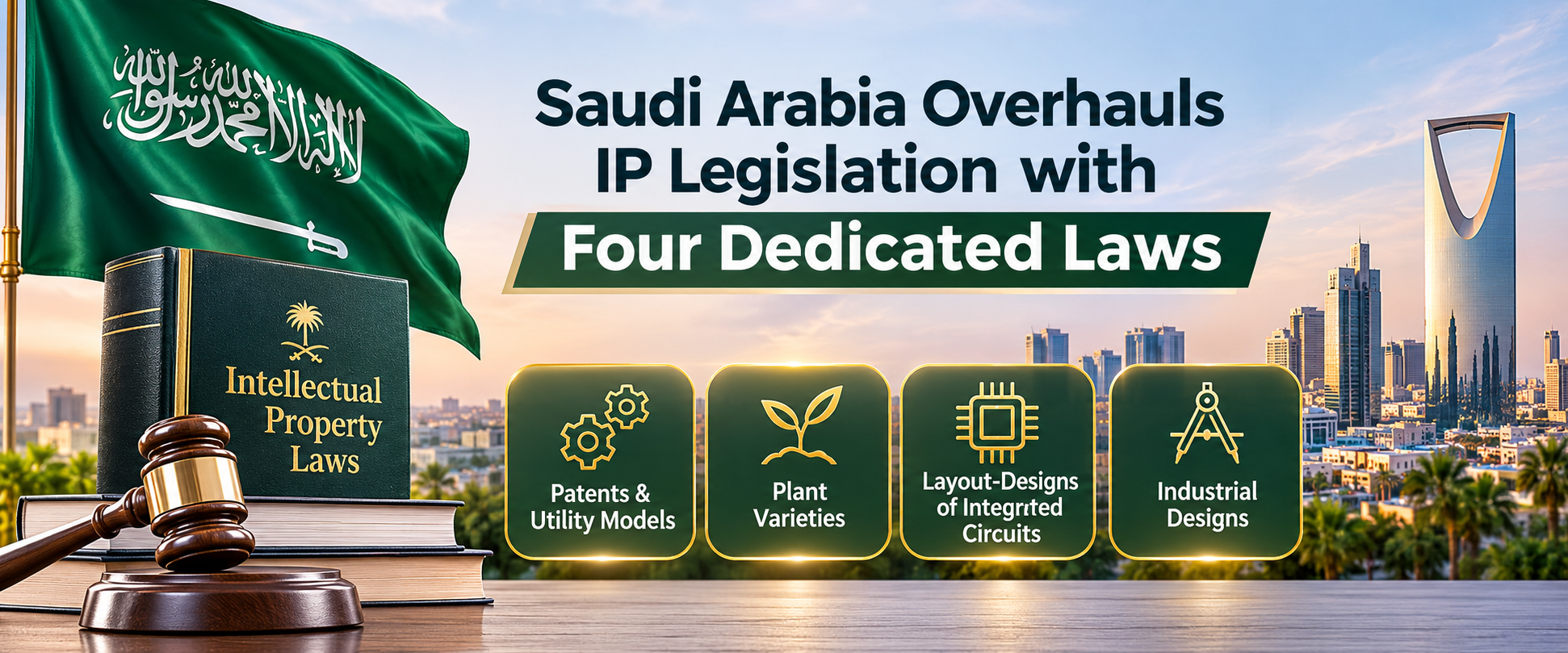
The four approved Saudi Arabia intellectual property laws are:
- Patents and Utility Models Law: protects inventions and introduces a dedicated framework for utility-model protection.
- Plant Varieties Law: protects qualifying new plant varieties and supports plant-breeding innovation.
- Layout-Designs of Integrated Circuits Law: protects the three-dimensional layout designs used in semiconductor integrated circuits and chips.
- Industrial Designs Law: protects industrial designs and aligns design-protection procedures with the Riyadh Design Law Treaty.
These are separate, sector-specific laws rather than a single consolidated IP code. They do not replace Saudi trademark or copyright law. Instead, they create or modernize dedicated protection frameworks for inventions, plant varieties, semiconductor layout designs, and industrial designs.
Transition from a Consolidated Statute
Previously, patents, layout-designs of integrated circuits, plant varieties, and industrial designs were governed by a single Saudi law: the Law on Patents, Layout-Designs of Integrated Circuits, Plant Varieties, and Industrial Designs. That law was issued by Royal Decree No. M/27 on 17 July 2004 and amended by Royal Decree No. M/45 on 25 September 2023.
- Legacy Structure: The earlier framework grouped four distinct areas of intellectual property into one statute, covering inventions, semiconductor layout designs, plant varieties, and industrial designs.
- Legal Unbundling: The Cabinet’s approval of four standalone laws separates these distinct IP categories into dedicated legal frameworks.
- Tailored Administration: This restructuring allows each category to be developed and administered through rules, procedures, and requirements suited to the nature of the relevant rights.
- Operational Dependence: The practical impact will depend on the final texts, implementing regulations, official fees, filing procedures, and commencement dates.
- Portfolio Impact: Businesses with inventions, semiconductor technology, plant-breeding assets, or design-led products should monitor how the new frameworks affect their existing and future IP portfolios.
Utility-Model Protection
The Patents and Utility Models Law introduces a dedicated utility-model framework within Saudi Arabia’s updated Saudi Arabia intellectual property laws. Utility models may offer an additional route to protect certain technical innovations. However, the final eligibility criteria, examination standards, fees, and processing timelines will be set out in the published law and implementing regulations.
- Target Audience: The new framework is relevant to businesses and inventors seeking protection for technical improvements, functional features, or innovations that may not meet the requirements for a standard patent.
- New IP Category: Unlike the previous consolidated framework, the updated law specifically establishes utility models as a separate category alongside patents.
- Unconfirmed Mechanics: The final scope of protection, examination approach, registration procedure, fees, and duration remain to be confirmed through official texts and SAIP guidance.
- Strategic Caution: Businesses should not assume that a utility model will automatically offer a faster or lower-cost alternative to a patent until implementing regulations and procedural requirements are published.
- Asset Assessment: Companies with incremental technical developments, product improvements, or manufacturing-related innovations should assess whether their assets may qualify for utility-model protection once further details are available.
Industrial Designs and the Riyadh Treaty
The Industrial Designs Law protects industrial designs and aligns design-protection procedures with the Riyadh Design Law Treaty, which Saudi Arabia ratified on 8 July 2026 following its adoption on 22 November 2024.
According to SAIP, this alignment is intended to simplify design-protection procedures and standardize procedural requirements in line with international practice.
Legislative Status
- Enactment Process: Cabinet approval is a major milestone, but the laws are not yet in force. They must first be formally issued via Royal Decrees and published in the Official Gazette, Umm Al-Qura.
- Pending Details: Key operational specifics remain unconfirmed, including final legal texts, implementing regulations, fee structures, filing mechanisms, and effective dates.
- Filing Guidance: Rights holders should not attempt filings or enforcement under these new frameworks until SAIP publishes official guidance and commencement dates.
Alignment with Broader Reforms
- Economic Context: These reforms support Saudi Arabia’s broader push to build a knowledge-based economy, boost investment, and encourage domestic R&D.
- International Integration: The updates complement Saudi Arabia joining the Madrid System on 8 October 2026, which simplified cross-border trademark protection.
- Scope of Laws: The approved statutes cover patents, utility models, plant varieties, integrated circuit designs, and industrial designs. They do not alter existing Saudi trademark or copyright laws.
What Rights Holders Should Monitor
Rights holders and applicants should consider reviewing their Saudi IP portfolios and monitoring official updates in the following areas:
- The publication of the full texts of the four laws in Umm Al-Qura.
- Royal Decrees, implementing regulations, and commencement provisions.
- SAIP filing procedures, official fees, and examination guidance.
- Transition arrangements for existing applications and registered rights.
- Detailed rules on utility-model eligibility, examination, and protection terms.