7 reasons for your patent application rejection
Patent

Why Most Patent Applications Get Rejected And How to Fix It

نُشر في Jul 24, 2026
آخر تحديث Jul 24, 2026
1 دقيقة قراءة

For inventors and businesses filing in the UAE, a patent rejection on the first review is more common than you'd think.

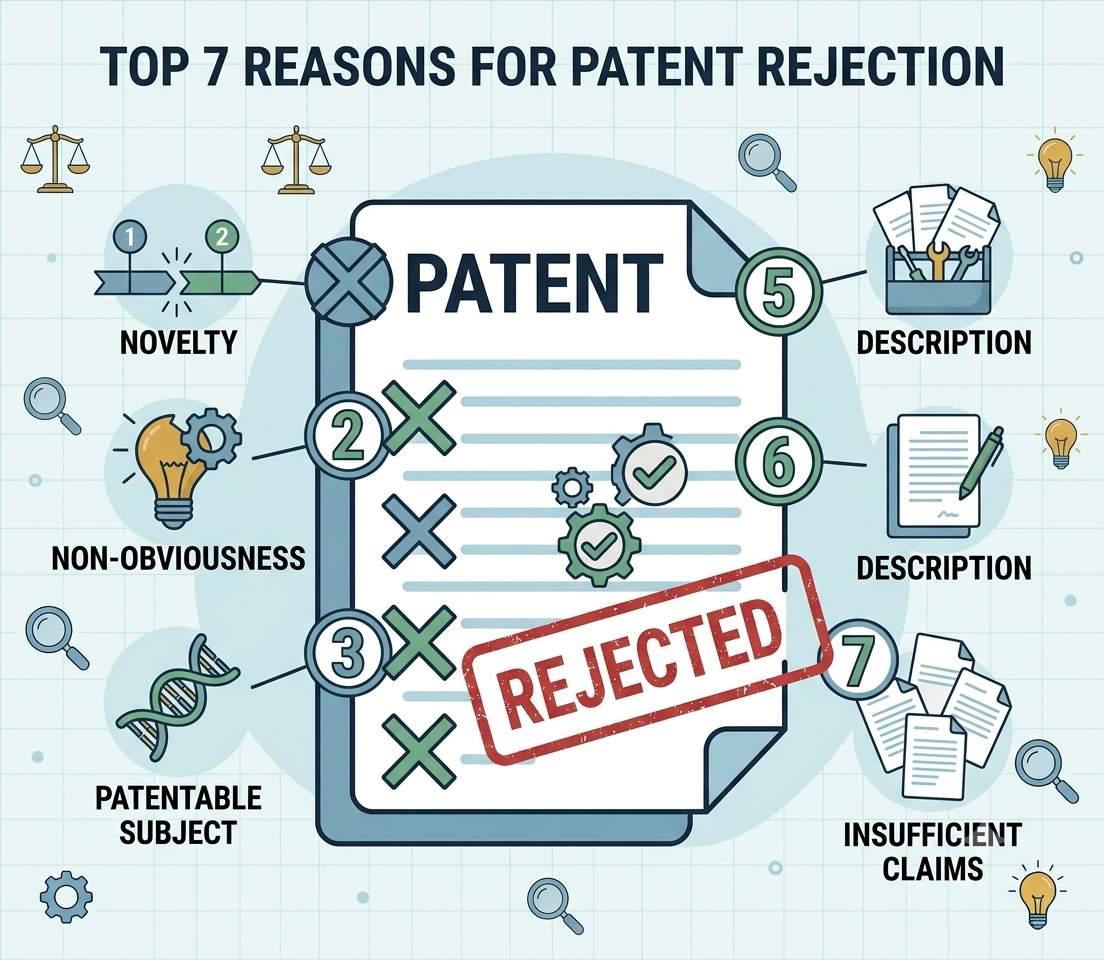
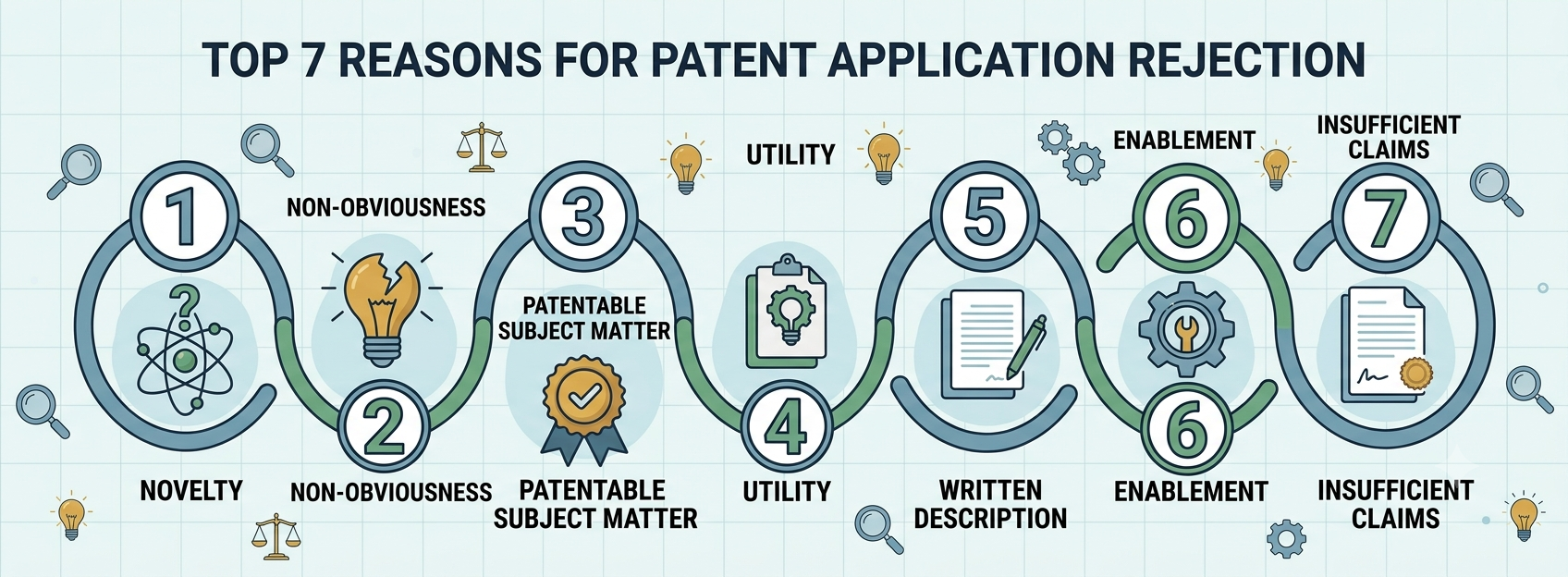
Most patent applications get rejected due to lack of novelty, lack of obviousness, unknown industrial capability, insufficient disclosure, excluded subject matter, overly broad claims, procedural defects and many more.

Knowing what examiners are checking for before you file can save you months of back-and-forth.

Know more on how to register patent application in UAE

Here are the seven most common reasons patent applications get rejected, your options if you're facing one, and the steps to how to handle your first patent rejection.

"

My Patent Got Rejected: What Are My Options Now? 

An initial rejection, often called an Office Action, is a normal part of the patent process, not the end of it. Most patent applications get rejected; here's why:

  • File a Grievance or Request Re-examination: Most patent offices, including the UAE Ministry of Economy (MoE), allow you to officially argue against a refusal in a fixed time frame, which is usually 60 days from the date of the decision.
  • Amend and Resubmit: If it appears the rejection was due to over-broad claims or unclear disclosure, then you can often narrow your claims or clarify your language without a reset of your filing date.
  • File a New Application: If your invention has changed significantly, or the original filing contains errors that cannot be amended, a new filing may be the better option. Please remember that this can affect your original priority date.
  • Consider a Utility Certificate: In jurisdictions like the UAE, inventions that offer a genuine technical solution but fall short of the high bar for "inventive step" may still qualify for a Utility Model Certificate, which comes with a shorter protection period but a lower approval threshold.
  • Appoint an IP Professional: When you receive a substantive rejection, it is a good time to engage a registered patent agent or intellectual property attorney who can build a well-supported response.
"

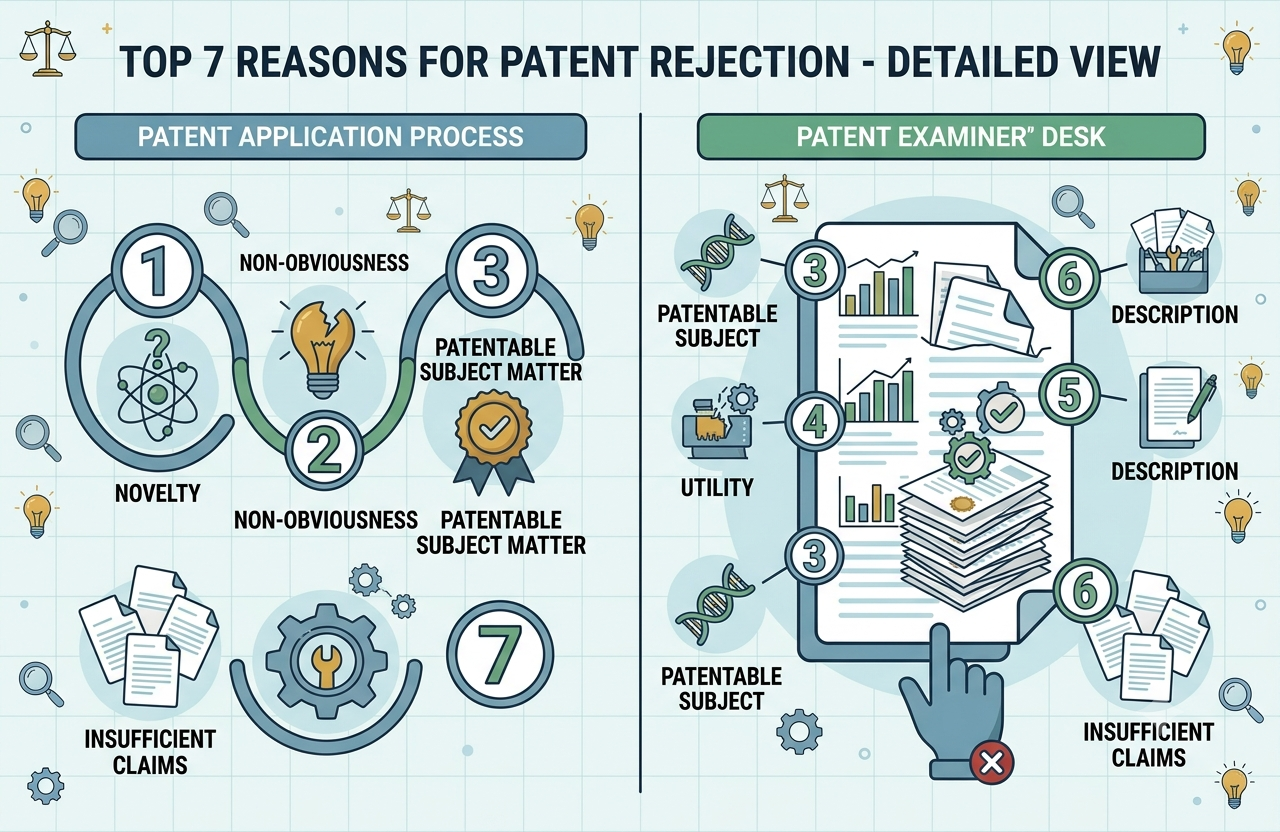
REASON #1: Lack of Novelty 

Before you file your patent, your invention has to be truly novel; that means it cannot have been disclosed anywhere in the world in any language before your filing date. Patent examiners scour international patent databases and more for evidence of your invention. If you find a single document that describes your invention perfectly, the application is automatically rejected. Nothing else matters until Novelty checks first and clears that bar.

REASON #2: Lack of Inventive Step (Obviousness)

Newness is not logically equated with non-obviousness. Your invention must also be something that a normal expert in that field would not have thought of easily. If an examiner feels that a person skilled in the art could have simply combined one or two existing technologies to arrive at your solution, then the application is rejected for lack of inventive step, even if no single document discloses your invention exactly.

REASON #3: Lack of Industrial Applicability

An invention patentable is something that can be made or used in industry, such as manufacturing or agricultural or healthcare, digital industry or service. Theoretical ideas, abstract notions, and the like don’t pass this test if they don’t have anything concrete to do or functional use.

REASON #4: Insufficient or Unclear Disclosure

Your application must make the invention clear enough for someone skilled in the field to make the invention without having to guess. Phrasing that lacks clarity, missing steps, weak diagrams, or descriptions that do not match your claims is commonly rejected here. No examiner can protect something that they can’t check its functionality.

REASON #5: Excluded Subject Matter

A patent is not available for everything. The scope of patentability does not extend to natural discoveries, scientific theories, and mathematical methods, as well as plant or animal varieties. In the UAE and many other jurisdictions, standalone software, business methods, and pure algorithms are also excluded from patent protection, and often fall under copyright law instead. A rejection will be nearly automatic if your invention is entirely limited to one of these categories. 

REASON #6: Poorly Drafted or Overly Broad Claims

Since the claims define the legal limits of your monopoly, the examiners do a close review of them. The examiner frequently rejects overly broad language, ambiguous wording, and unsupported technical description claims. The most preventable rejection that may happen; nevertheless, it is still a common occurrence as inventors draft claims without legal assistance.

REASON #7: Formal and Procedural Defects

Often, the denial of the invention does not relate to the invention at all. A missing authorization document and incomplete translation into Arabic or English, along with unpaid fees or a missing assignment deed, can delay or sink an application. You can usually rectify these issues but only if you solve them within the strict timetable imposed by the patent office.


how to handle patent application rejection

The 5 Things You Should Do Before Filing to Prevent Rejection

  • Conduct a Rigorous Prior Art Search: Before investing in filing fees, examine patent registers in other countries and in the public space. This confirms your invention is in fact unique.
  • Work with a Registered Patent Agent: The structure of intellectual property differs for brands and patents. A strong draft keeps your claims strong, defensible, and consistent with your specification.
  • Maintain Strict Confidentiality Until You File: The novelty of your invention may be affected by your presentation at a conference, product demo, or paper publication. UAE permits a 12-month grace period for an inventor's own disclosures; however, most countries do not recognize the same. Revealing your intention to expand internationally before filing can backfire.
  • Write a Comprehensive Technical Description: Your specification should detail any technical data that is specifically required to enable your invention to function; this will include diagrams and step-by-step instructions that will support the full extent of your claims.
  • Organize Formalities Early: The translation of the certificate of incorporation, trade license, power of attorney and payment of the professional fee must be arranged in advance, so that the paperwork does not hold up the filing.

Most patent applications get rejected; here's why: avoidable gaps, not weak ideas, and that's exactly what our team helps you fix. Your patent journey doesn't have to end with a rejection. Abou Naja Intellectual Property engages with inventors and businesses throughout the UAE to respond to Office Actions, amplify weak applications and file complaints in chronological order.  

Reach out to us today to discuss your case.

FAQs

How long does it take to respond to a patent rejection in the UAE? 

Within 60 days, a formal grievance against the rejection can be filed with the Industrial Property Grievance Committee, Ministry of Economy.

Can a rejected patent application be resubmitted? 

Yes. During the period in which you can file your Response, you can seek a re-examination or file a completely new application. If it is rejected with a clear lack of novelty, re-filing the application without altering the invention or limiting the claims is likely to yield the same result.

How is a patent rejection in the UAE different from a USPTO rejection? 

In the UAE, for a final substantive rejection, an appeal to the Industrial Property Grievance Committee must be filed within 60 days, with further appeals to the Federal Courts. An Office Action is a letter issued by the USPTO that communicates rejections. The applicant may respond through argument, amendment of claims, a Request for Continued Examination (RCE), or by appeal to the Patent Trial and Appeal Board (PTAB). While procedures may vary, the essentials of novelty, inventive step and clarity remain intact.

What is the difference between a patent rejection and a patent objection?

An objection is an indication of a clerical-type problem that can be fixed by amending the wording. A rejection carries more weight, indicating that the examiner found the invention or claims are not novel or useful, on the merits, of a legal requirement.

Can I file a patent in the UAE after disclosing my invention publicly? 

Indeed, just be sure to act fast. Under UAE patent laws, a 12-month grace period is available where the public disclosure is made by or derived from the inventor. If you file within 12 months of that disclosure, it won’t damage your novelty in the UAE. Nonetheless, filing before any public disclosure is always safest because many foreign jurisdictions do not offer the same grace period.

How much does it cost to respond to a patent rejection in the UAE?

According to the latest fee schedule from the Ministry of Economy, individuals, SMEs and academic institutions have to pay AED 500, while a standard company pays AED 1,000 to formally appeal. A full re-examination request for SMEs and academic institutions costs AED 2,500, and AED 5,000 for standard companies. Patent attorney expenses not incurred from outside are excluded from the above-mentioned fees.
شارك هذا المقال