AI and IP
Intellectual Property

Artificial Intelligence and Intellectual Property: Protecting Your Creations

发布于 Jan 01, 1970
更新于 Jul 31, 2026
1 分钟阅读

Introduction: Where AI Meets IP Law

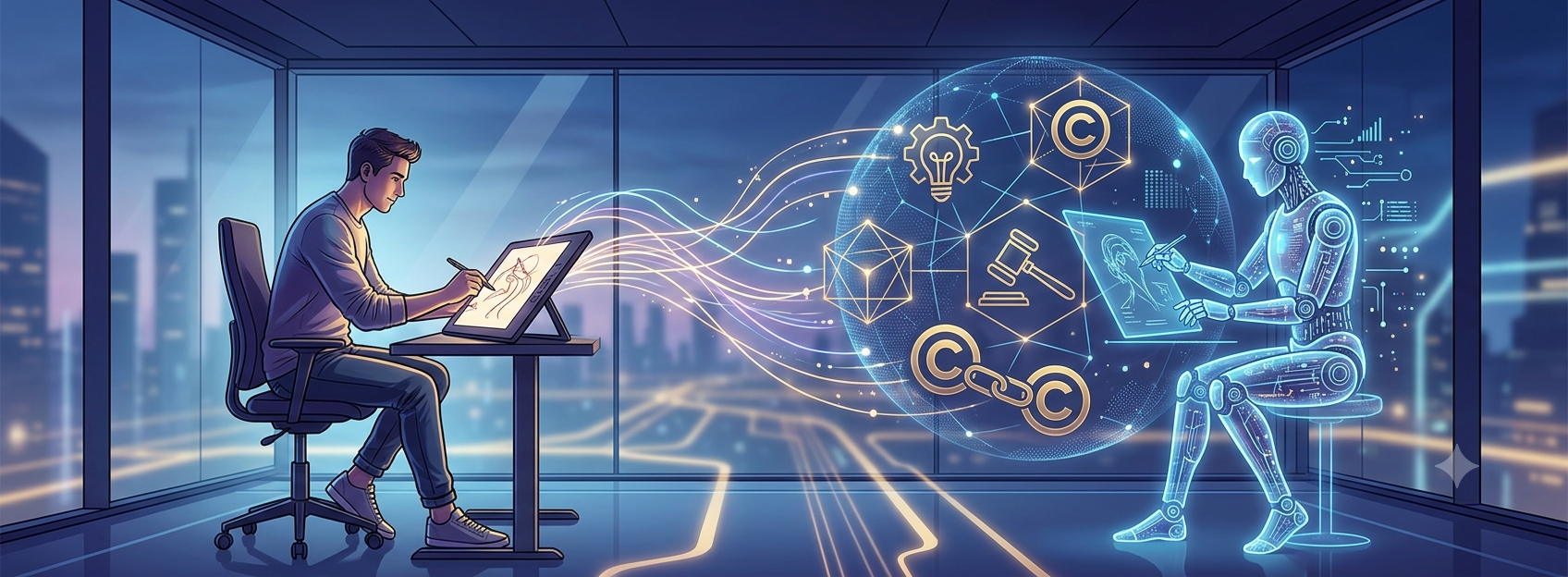
Generative AI now drafts contracts, designs logos, writes code, and proposes inventions. This is pushing AI and intellectual property into direct conflict: UAE and global IP law were built on a simple assumption: that a human creates the work. That assumption no longer stands valid against how a lot of content and inventions actually get made, and the gap between what AI can produce and what the law will protect creates real risk for businesses.

Key Takeaways

  • UAE law requires a human author or inventor. AI cannot hold copyright or be named as a patent inventor.

  • Fully AI-generated output is unlikely to qualify for copyright protection. AI-assisted work can qualify if a human's creative input is documented.

  • Federal Law No. 11 of 2021 limits patent inventorship to natural persons and excludes software itself from patentability.

  • Businesses using generative AI face trademark and infringement risk from AI-generated brand assets and unclear training-data sources.

  • Contracts, documentation, and early registration are the most reliable ways to protect your position while AI intellectual property law in the UAE catches up.


Can AI-Generated Work Be Protected? Copyright in the Age of AI

Questions about AI-generated content copyright come up constantly as businesses adopt these tools, and the UAE answer depends heavily on how much a human actually shaped the final output.

UAE Copyright Law and the "Human Authorship" Requirement

The UAE's Federal Decree-Law No. 38 of 2021, which protects original works, whether literary, artistic or software, based on human authorship, does not have any specific provisions regarding AI. Hence, the protection will be assessed as per the extent of human creativity input.

AI-Assisted vs. Fully AI-Generated Works

A creative computer output is a work produced with the use of artificial intelligence (AI). This work may be protectable where a human exercises sufficient creative authorship. In particular, a human must guide, refine, and materially shape the output.  In such cases, the human (not the machine) will be recognized as the author. When the human’s role is only to provide a prompt and accept the result without modification, the work is far less likely to be original and thus not generally copyrightable.

What This Means for Businesses Using AI Tools

The question can AI own a patent? has been tested in courts across the US, UK, Europe, and Australia, with consistent rulings against AI inventorship. Under current laws in most jurisdictions, including the UAE, the answer is no. 

If AI tools create your marketing copy, code or designs, you may not have enforceable rights unless you can prove significant human involvement. Maintaining documentation of human input is now mandatory by law and not just recommended.

Patents and AI: Can an Algorithm Be an Inventor?

UAE Patent Law and Inventorship Requirements

Federal Law No. 11 of 2021 on the Regulation and Protection of Industrial Property Rights limits inventor status to natural persons. It also excludes software itself from patentable subject matter, though software tied to a genuine technical effect can still qualify.

Protecting AI Models, Training Methods and Algorithms

Because the algorithm itself is usually not a patentable invention, businesses often rely upon trade secret protection, confidentiality agreements, and specific IP clauses in employment and contractor agreements to protect models, training methods, and datasets.

Global Precedents (DABUS) and What They Signal

Stephen Thaler tried to name his AI system, DABUS, as the sole inventor on several patent applications. Patent offices and courts in the US, UK, EU, Australia, and Germany rejected this. Japan's Supreme Court did the same in March 2026, closing a seven-year legal battle. Only South Africa, which does not substantively examine applications, and Saudi Arabia have accepted DABUS filings. The pattern across jurisdictions is consistent: a human must be identifiable in the inventive process.

Trademarks in the Age of AI

As questions about AI and intellectual property extend beyond copyright and patents, trademarks face their own set of risks. Trademarks in the UAE are governed by Federal Decree-Law No. 36 of 2021 on Trademarks. Like the copyright and patent regimes, it was not written with AI tools in mind, so the risks below sit outside the law's direct scope. 

  • AI-Generated Brand Names, Logos and Content Risks

AI tools trained on large datasets can generate names, taglines, or logos that similarly resemble existing registered marks. This may subject a business to opposition or infringement claims that it never meant to create.

  • Infringement Exposure When Using Generative AI Tools

AI providers do not guarantee their output is free of third-party rights. If you use generative tools for branding, you carry that infringement risk yourself. Clearance searches before adoption remain essential.

Global Legal Trends

Across some of the world’s major jurisdictions, including the US, the UK, the EU, Japan and Australia, a clear consensus has emerged: copyright and patent law require a human author or inventor. Patent offices and courts repeatedly reject claims of AI as the inventor. The USPTO may find inspiration in these international frameworks. 

The EU AI Act entered into force in August 2024, but its transparency obligations on a provider of general-purpose AI, such as disclosure of training data sources, will only take effect in August 2025. There is currently no such rule in the UAE, but that gap may narrow in due course.

Key IP Risks Businesses Face When Using AI

  • Unclear or unenforceable ownership of AI-generated deliverables
  • Trade secrets exposed through prompts entered into third-party AI tools
  • Trademark clearance gaps in AI-suggested branding
  • Contracts that don't address who owns AI-generated work
  • Disputes over training-data sources as AI regulation develops

How to Protect Your Creations: A Practical Roadmap

  • Document Human Creative or Inventive Contribution

Retain records of important nudges, changes, and decisions showing where a person shaped the final work. It is this record that distinguishes a protected asset from unprotected AI output

  • Update Contracts and IP Assignment Clauses to Cover AI Use

Employment, contractor, and vendor agreements need to state who owns AI-assisted work, how disclosure of use occurs, and what confidentiality rules apply to prompts and outputs.

  • Register Trademarks and Patents Early, Before AI-Assisted Iteration

Once your mark or invention is finalized, file for protection immediately. When multiple rounds of AI-assisted changes are made, it becomes more difficult to prove contribution.

  • Run Periodic IP Audits on AI-Generated Assets

Frequently review your portfolio of AI-generated content, code, and branding to verify ownership is documented and enforceable.


Best Practices Checklist for Businesses Using AI

  • Record human input at every stage of AI-assisted creation
  • Add AI-specific clauses to employment and vendor contracts
  • Run trademark clearance checks before using AI-suggested branding
  • Treat proprietary models and training data as trade secrets
  • Review AI vendor terms for IP indemnities and data use rights
  • Audit AI-generated assets every year


Intellectual property right and ai

FAQs

1. Is AI-generated content protected by copyright in the UAE? 

Only if a person's creative contribution can be shown. AI-generated content copyright protection under Federal Decree-Law No. 38 of 2021 generally does not extend to output with no meaningful human input.

2. Can an AI be listed as an inventor on a patent? 

No. Federal Law No. 11 of 2021 requires the inventor to be a human being. Patent offices and courts in the US, UK, Europe, Australia, Germany, and Japan have all reached the same conclusion.

3. Who owns IP created using AI tools: the company, employee, or AI provider? 

The question of property depends on the contract. If the contract does not include clear clauses on ownership in respect of AI-generated works, the title and usage rights may be unclear.  You need to amend your agreements to reduce the chances of dispute later.

4. Is it risky to use AI tools trained on copyrighted material? 

Yes. If the output closely resembles a protected work, or if questions arise later about the training data, your business can face exposure for using that output.

5. Do UAE free zones like DIFC apply different IP rules to AI-generated work?

DIFC has its own IP Law (DIFC Law No. 4 of 2019), separate from federal law. If you operate in a free zone, confirm which regime applies to your work before relying on it.

How Abou Naja Can Help

The law is still catching up to AI. Your strategy around AI and intellectual property shouldn't have to wait for it. AbouNaja helps you document human contribution, update your contracts, and register what's yours before AI-assisted iteration blurs the ownership trail. Get in touch to protect your work now!

分享这篇文章