Key Takeaways
- Understanding passing off vs infringement in trademark is essential to the use of unregistered marks.
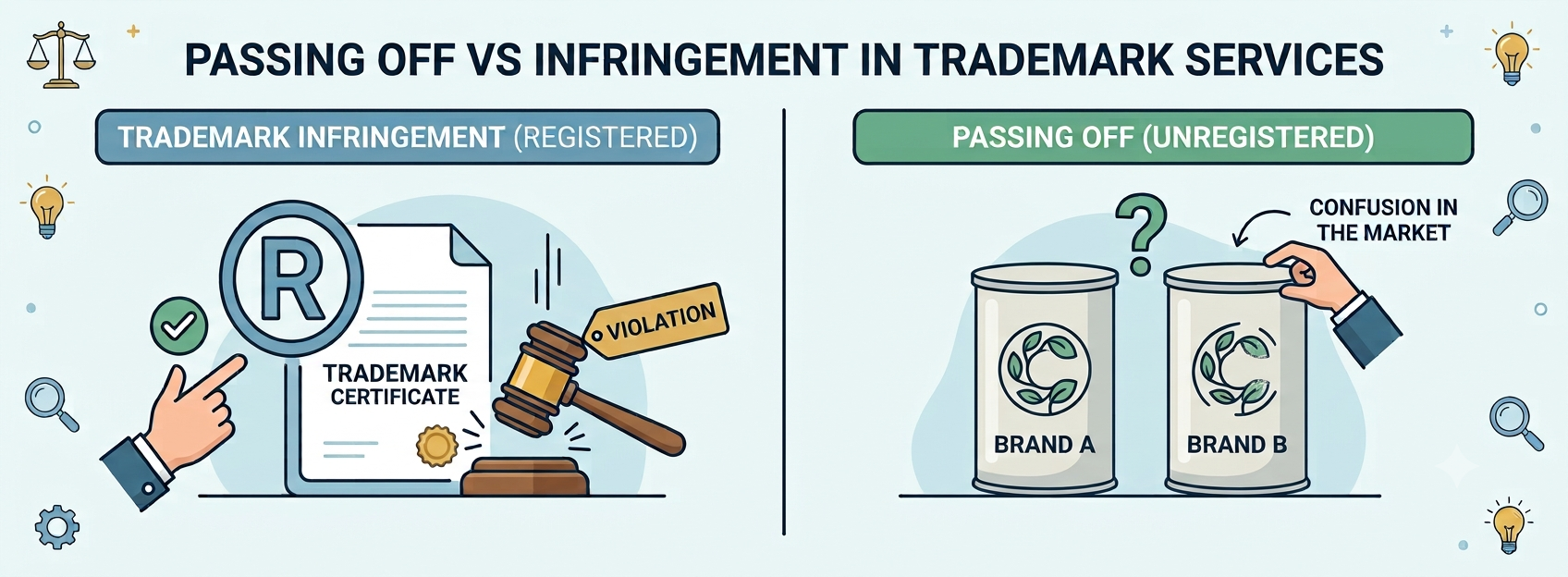
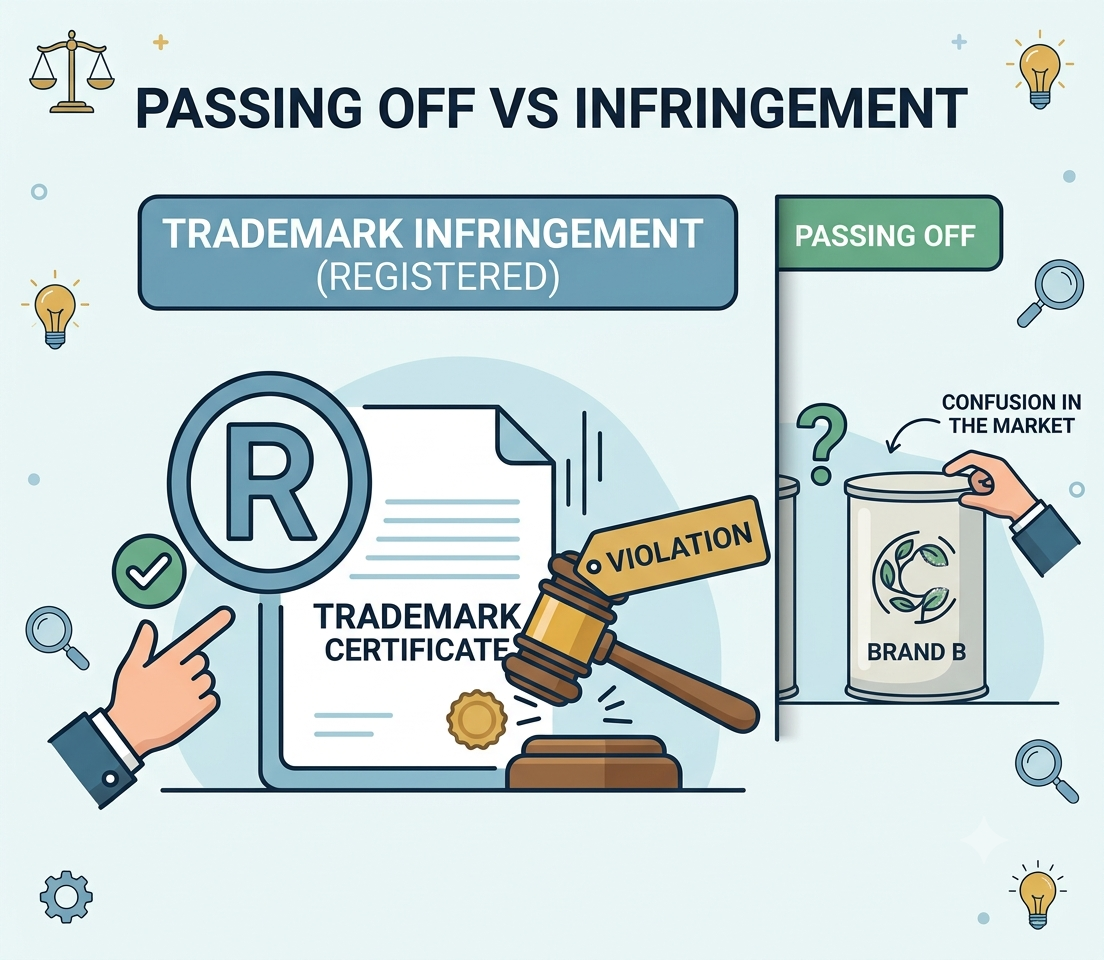
- Passing off applies to unregistered marks through common law, while trademark infringement is a statutory remedy available only to registered trademark owners.
- A passing off claim requires proof of three elements: goodwill, misrepresentation, and damage.
- Trademark infringement has a lower burden of proof because registration itself proves ownership.
- Both claims can be filed in the same case in jurisdictions that recognize both.
- Passing off is available to unregistered brands, but it is slower, costlier, and harder to win than infringement.
Introduction
When considering passing off vs infringement in trademark, both concern the unauthorized use of another party's brand identity. However, they differ in their legal nature, applicability, and burden of proof. The choice of which one to apply depends largely on whether the trademark is registered or not.
What is Trademark Infringement?
Trademark infringement occurs when an identical trademark or one closely resembling it is utilized without permission in the production of the same or deceptively similar goods and services.
The Federal Decree-Law No. 36 of 2021 on Trademarks governs infringement in the UAE. When a mark is registered, it is taken to be conclusive proof of ownership. As such, the owner is not required to prove earlier use or reputation.
Some available civil remedies under UAE law are injunctions, damages and account of profits. Infringing goods can also be applied for seizure and detention by the owner. Criminal penalties can also result in imprisonment along with fines of up to AED 1,000,000. You can register a trademark with the UAE Ministry of Economy.
What is Passing Off?
The remedy of passing off is used in common law for unregistered trade marks. It applies when one party misrepresents its ethereal products or services as being the goods or services of another entity, thereby causing confusion and deception among the public and further harm to the party.
Passing off does not require registration. A business with established market recognition can bring a passing off claim even without a registered mark. The claimant must satisfy the Classical Trinity Test, established in Reckitt & Colman Products Ltd v. Borden Inc. [1990] and adopted by Indian courts:
- Goodwill: an established reputation that consumers associate with the brand.
- Misrepresentation: a false representation likely to deceive consumers about the source of the goods or services.
- Damage: actual or likely harm to the claimant's goodwill or business.
How Different Countries Approach This
The treatment of passing off vs infringement in trademark law varies considerably across jurisdictions.
United Kingdom: The doctrine has its origins in the United Kingdom. The case of Reckitt & Colman v. Borden [1990] regarding the Trinity Test is still a leading authority on this doctrine. The Trade Marks Act specifies the causes of action for infringement.
India: In India, the legal doctrine of passing off is enshrined in section 27(2) of the Trade Marks Act, 1999, which saves the common law right of the trademark owner. In Passing Off claims, courts concurrently apply the Trinity Test.
United Arab Emirates: UAE law does not recognize a cause of action for passing off as common law jurisdictions do. If you own a registered trademark, you are granted legal protection under Federal Decree-Law No. 36 of 2021. Municipal laws, on the other hand, offer limited legal recourse. In other words, if you own an unregistered mark, your options are limited to provisions on unfair competition under commercial laws.
United States: The Lanham Act covers the concept of infringement. Under this Act, anyone, including the owner of an unregistered mark, can bring an unfair competition claim against false designation of origin, even if not registered.
Australia: Australia's common law recognizes the tort of passing off. Nonetheless, the provisions regarding misleading or deceptive conduct in Australian Consumer Law often afford a wider remedy.
Canada: Canada's common law recognizes passing off, which is also partly codified in the Trademarks Act under Section 7(b). A claim may be filed for refund and demand together.
Landmark Indian Cases
Reckitt & Colman Products Ltd v. Borden Inc.: Established the Classical Trinity Test adopted by Indian courts.
Cadila Healthcare Ltd v. Cadila Pharmaceuticals Ltd [2001] (Supreme Court of India): The Supreme Court held that the pharmaceutical sector demands a higher standard of care, as even minor similarities between trade names risk serious harm to consumers and public health.
Laxmikant V. Patel v. Chetanbhai Shah [2002] (Supreme Court of India): The Court confirmed that prior use of an unregistered trade name is sufficient to restrain imitation, granting an interim injunction based on established use and reputation alone.
Mahendra & Mahendra Paper Mills Ltd v. Mahindra & Mahindra Ltd [2002] (Supreme Court of India): The Supreme Court found the competing trade name deceptively similar, creating a likelihood of confusion among consumers, and ruled in favour of the established mark holder, reinforcing passing off protection for trade names.
Satyam Infoway Ltd v. Siffynet Solutions Pvt Ltd [2004] (Supreme Court of India): The Supreme Court held that domain names perform a trademark function by identifying commercial sources online, extending passing off protection to domain names and equating their legal standing with traditional trademarks.
Colgate Palmolive Company v. Anchor Health & Beauty Care Pvt Ltd [2003] (Delhi High Court): The Delhi High Court granted injunctive relief on both infringement and passing off grounds, confirming that the two causes of action are complementary and may be pursued concurrently within the same proceedings, without requiring the plaintiff to elect between them.
Which Action Should You Choose?
Passing off vs infringement in trademark is a practical distinction that directly affects which legal route is available to you. The decision depends on the nature of your trademark rights and the strength of your evidence.
- Choose trademark infringement if your mark is registered. It requires less proof, and registration alone establishes your rights. You get access to both civil and criminal remedies.
- Passing off: if your mark is not registered but you have built market recognition. You will need evidence of goodwill (invoices, advertising records, customer testimonials, media coverage), proof of misleading conduct, and proof of actual or likely damage.
- Choose both: if your trademark is registered and you also want to protect goodwill beyond the registered specification.
For businesses in the UAE, the recommendation is to register the trademark early. UAE law is built on statutory protection, not common law goodwill. Registration provides an immediate, enforceable right without the need to prove reputation in court.
FAQs
What is the difference between passing off and trademark infringement?
Infringement protects registered trademarks under statute and has a lower burden of proof, with access to criminal remedies. Passing off protects unregistered marks but requires proof of goodwill, misrepresentation, and damage.
Can you sue for passing off without a registered trademark?
Yes. You must prove established goodwill, a misleading representation by the defendant, and resulting or likely damage. The burden of proof is higher than for infringement.
Is passing off available in the UAE?
No, not as a standalone tort. UAE trademark protection is governed by Federal Decree-Law No. 36 of 2021. Unregistered marks have limited recourse through unfair competition provisions. Registration is recommended.
What countries recognize the tort of passing off?
Common law jurisdictions, including the UK, India, Canada, and Australia. The US provides an equivalent through Section 43(a) of the Lanham Act. Civil law countries such as the UAE, France, and Germany rely on unfair competition law instead.
Can passing off and trademark infringement be claimed together?
Yes. Businesses weighing passing off vs infringement in trademark proceedings can file both actions in the same proceeding in jurisdictions including India, the UK, Canada, and Australia, to protect registered rights and broader goodwill simultaneously.