
What the draft covers
The official draft text is currently available in Arabic. While the Istitlaa consultation platform provides an English-language interface, the authoritative draft document published by the Saudi Authority for Intellectual Property is in Arabic. Businesses should therefore rely on an Arabic-language review, or obtain a professionally verified English translation, before making compliance or contractual decisions.
- Standalone legal framework: The proposed Saudi Trade Secrets Law seeks to replace the current reliance on the Regulations for the Protection of Confidential Commercial Information with a clearer, standalone statutory framework.
- Alignment with national law: According to the official consultation record, the project aims to ensure consistency with national legislation and general legal principles.
- Protection in court proceedings: The draft provides for the protection of trade secrets during judicial proceedings, helping reduce the risk that sensitive commercial information is further disclosed through litigation.
- Eligibility for protection: The proposal is designed to define the conditions under which confidential commercial information may qualify as a protectable trade secret.
- Limits on protection: A trade secret will not be protected if it violates religious, moral, or cultural standards.
- Rights of trade-secret owners: It clarifies the rights of trade-secret owners to use, transfer, license, or otherwise exploit their confidential business information.
- Enforcement mechanisms: The draft establishes mechanisms for enforcing trade-secret rights, including remedies for infringement and procedures for addressing misuse of protected information.
- Practical importance for businesses: These provisions may be particularly significant for companies handling technical know-how, customer data, pricing information, business plans, source code, supplier information, and other commercially sensitive material.
Rights and remedies
- Clearer statutory rights: Under the draft, owners of protected trade secrets would receive clearer statutory rights to use, transfer, license, or otherwise exploit their confidential business information.
- Civil remedies: The proposal provides for civil remedies, including compensation for infringement of protected trade secrets.
- Criminal liability for intentional violations: The draft introduces criminal liability for intentional violations involving protected trade secrets.
- Potential imprisonment: A person who commits a specified infringement may face imprisonment for up to three years.
- Financial penalties: The draft provides for a fine of up to SAR 1 million for a specified infringement.
- Combined penalties: A person found liable may face both imprisonment and a fine, depending on the circumstances of the violation.
- Preservation of stricter penalties: The proposed penalties apply without prejudice to any stricter penalty available under another applicable Saudi law.
Documentation and enforcement
- Optional documentation service: A notable feature of the proposal is an optional documentation service, which could help businesses create a record of the confidential information they claim to own.
- Confidential handling: The documentation service shall be conducted under confidentiality and non-disclosure of the information being documented.
- Evidence of ownership: Such documentation may become important when proving ownership, secrecy, or the scope of the information in a dispute.
- Limits of documentation: Documentation shall not constitute proof of ownership of the information, legitimacy of acquisition, or its compliance with the conditions for protection stipulated in Article 2 of the Law.
- Implementing regulations: The draft contemplates implementing regulations to be issued by the relevant council.
- Operational details to follow: Businesses should monitor not only the final law but also the executive regulations, which are likely to determine important operational details such as procedures, evidentiary requirements, and enforcement processes.
What businesses should do?
The draft Saudi Trade Secrets Law is a signal that companies should treat confidential commercial information as a distinct and enforceable business asset. Companies operating in Saudi Arabia, entering the Saudi market, or sharing sensitive information with Saudi counterparties should begin reviewing their confidentiality framework now, rather than waiting for enactment.
- Identify confidential information: Businesses should identify and classify commercially valuable confidential information, including technical know-how, source code, customer and supplier data, pricing, business plans, formulations, and internal processes.
- Review contractual protections: Companies should review NDAs, employment contracts, contractor agreements, IP-assignment clauses, and confidentiality policies to ensure they clearly define protected information and obligations after termination.
- Strengthen internal safeguards: Businesses should strengthen technical and organisational safeguards, including access controls, encryption, need-to-know access, employee training, logging, and incident-response procedures.
- Preserve evidence: Companies should maintain evidence of ownership and secrecy measures, including creation records, access restrictions, confidentiality markings, and internal distribution controls.
- Assess third-party exposure: Businesses should assess exposure relating to departing employees, partners, vendors, and former service providers.
- Prepare an enforcement strategy: Companies should prepare an enforcement strategy covering preservation of evidence, cease-and-desist action, civil claims, and potential criminal referral where appropriate.
Consultation deadline
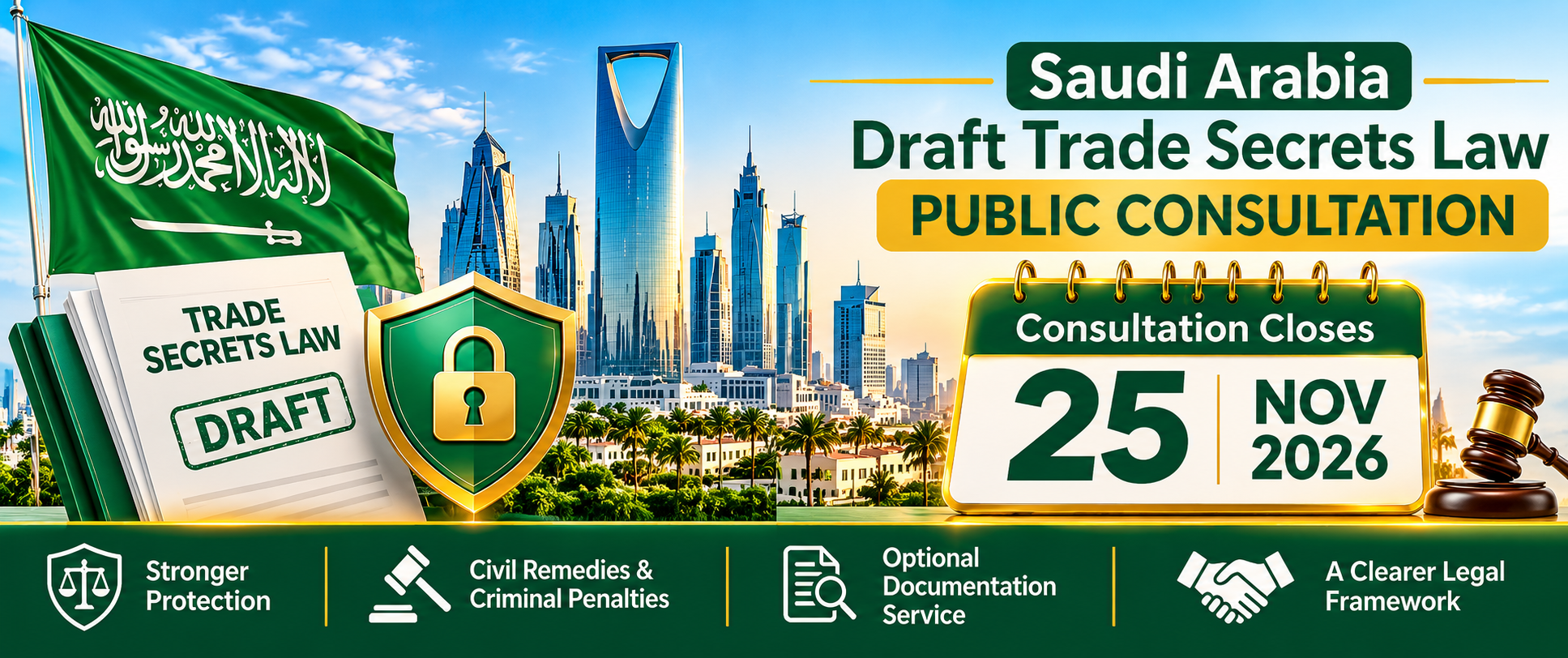
Public feedback on the draft Saudi Trade Secrets Law is open until 25 November 2026. The consultation is open to individuals, private-sector organisations, and government entities, allowing affected businesses to submit comments before the proposal advances.
Because the text remains subject to change, companies should not assume that the current penalty levels, definitions, remedies, or implementation timeline will remain unchanged in the final version. However, the direction of reform is clear: Saudi Arabia is moving toward a more explicit and enforceable regime for trade-secret protection.
Contact Abou Naja IP today for guidance on protecting your trade secrets in Saudi Arabia.